
Navin B. Ramakrishna
@NavinBrian
Followers
851
Following
7K
Media
59
Statuses
1K
Sr Research Fellow @JayShin lab, Genome Inst Singapore /collab @ReversadeLab /PhD @EricMiskaLab & Azim Surani Lab, Gurdon Inst, Cambridge /Biochem Grad, Oxford
Singapore 🇸🇬/Cambridge 🇬🇧
Joined January 2011
Excited to share our Review on human PGC development covering the latest in vivo observations & in vitro developments, particularly in the last 5 years. If you’re interested – have a read! https://t.co/UI7QEG6TI3 From: @astar_gis @karolinskainst @uniofwarwick @GurdonInstitute

journals.biologists.com
Summary: This Review examines recent insights into early human germ cell development and how these regulatory principles guide stem cell-derived models aiming to reconstitute human gametogenesis in...
1
2
8

Nature research paper: Uncovering the role of LINE-1 in the evolution of lung adenocarcinoma https://t.co/QQHfaXbXcE

nature.com
Nature - Lung adenocarcinomas bearing the ID2 mutational signature display increased LINE-1 retrotransposon activity, which contributes to their fast evolutionary dynamics and aggressive phenotype.
3
27
94

How do different tissues silence different genes? In CRISPRi, genes are silenced by a potent repressor TRIM28; we discovered a special version, TRIM66, that is only expressed in nose, testis, & cancer. It controls smell & behaviors. Now in @NatureComms:

nature.com
Nature Communications - In our nose, each mature olfactory sensory neuron expresses only one out of 1,000 olfactory receptor genes. This study shows that an epigenetic repressor, TRIM66 ensures...
1
16
78

I don't think scientists should work for anyone else. They should work for discovery and for their own curiosity. – Maria Leptin, ERC President @mleptin on 'The Night Science Podcast' @nightsciencepod
9
23
144
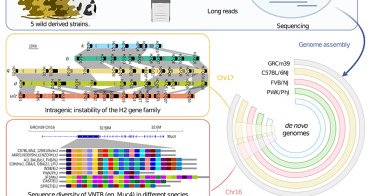
High-quality mouse reference genomes [PacBio Long Read genomes of 17 strains] reveal the structural complexity of the murine protein-coding landscape, Cell Genomics. https://t.co/KTl0OrBfJQ Genomes and annotations here:
cell.com
Helmy et al. provide a collection of high-quality mouse reference genomes. They were able to resolve some of the most complex regions among mouse genomes that are involved in immune defense. These...
0
0
1

High-quality mouse reference genomes reveal the structural complexity of the murine protein-coding landscape
cell.com
Helmy et al. provide a collection of high-quality mouse reference genomes. They were able to resolve some of the most complex regions among mouse genomes that are involved in immune defense. These...
1
6
13

Congrats to @juliaschaepe and @marklundem on the recent publication of their work linking the binding behaviors of TFs in vitro and in vivo! Out in Cell now:

cell.com
In vitro-derived insights into features that drive transcription factor binding to DNA, including motif-adjacent sequence, enable prediction of chromatin states and transcription factor occupancy in...
2
24
108

Today in @Nature we report a new prime editing strategy that can rescue a common cause of many genetic diseases in a disease-agnostic manner. This approach converts a redundant endogenous tRNA into an optimized suppressor tRNA, enabling a single prime edit to rescue premature
34
398
1K
Research Highlight: Mouse In vitro oogenesis breaks free of the ovary https://t.co/ikYw0Ud3Gb
@Dev_Cell
0
0
2

Enjoyed reading the recent paper from gnomAD team on the modifiers of penetrance of clinically-relevant variants in 800k individuals in the gnomAD database. One example highlighted in the paper is extremely fascinating! It's a beautiful example of a loss of function (LOF)
3
35
143

Why fundamental research is fundamental to progress, seeding major breakthroughs Editorial @Nature this week And 7 basic science discoveries that changed the world https://t.co/0YrKabc7ff
https://t.co/SM11QSJhWz
6
205
561

For over 20 years, the mouse model organism has helped scientists uncover the biology behind human health and disease. But the mouse reference genomes still have missing pieces. The first collection of telomere-to-telomere mouse genomes are available for two key mouse strains.
2
2
6
Learn more in the open access Nature Genetics paper:

nature.com
Nature Genetics - Telomere-to-telomere assemblies of two mouse inbred strains, C57BL/6J and CAST/EiJ, offer improvements over the current mouse reference genome by adding telomere and centromere...
0
1
2
Age-related mutations give sperm-forming stem cells a selective advantage during sperm production, shaping disease risk and genetic variation in offspring https://t.co/w2pWRExbh1

nature.com
Nature - Age-related mutations give sperm-forming stem cells a selective advantage during sperm production, shaping disease risk and genetic variation in offspring.
3
37
139
The quest to make babies with lab-grown eggs and sperm. An excellent news feature by Nature: tempered optimism, with critical caveats underscored. And great to see commentary from so many names in the field! https://t.co/WKIsKUB6OQ
0
1
1

The human genome encodes 391 odorant receptor genes. Most of the proteins they encode, though, haven't been expressed in vitro. We don't know what they sense. A new study reports a better way to express odorant receptors in the lab. The authors find receptors for
12
52
454

🧬 New review on nanopore base-calling models is out! Congrats to Sonia Cruciani (former Novoa Lab PhD, now postdoc at the Deplancke Lab, EPFL) and @EvaMariaNovoa 📖 Read it here: https://t.co/6pXI36TKDu 👏👏👏
0
3
7

📢 ANNOUNCEMENT! Looking to pursue cutting-edge research in early development, maternal-fetal interaction, or placental biology? Open for applications: - Funded PhD https://t.co/BbYSvHV5iw - Next Generation Fellowship https://t.co/9ulJ7yTcmU - MPhil https://t.co/iIcCi4oQ27
0
6
4
🚨Jobs alert: Want to join our growing team, working on epigenetics in stem cell models of reproduction and pluripotency? We are looking for enthusiastic new lab members as part of the Postdoc, PhD, and MSc student recruitment campaign of our centre:

event.fourwaves.com
1
4
5
Sad to hear this. John was a brilliant scientist and also someone who engaged with everyone personally & as equals, especially young scientists and students.

0
0
1
Very candid responses from Azim Surani here on his initially turbulent scientific journey, & accounts of genomic imprinting and the pioneering of mammalian scRNA-seq. Great to see this put together by Ashley Moffett & @GeraldineJowett

journals.biologists.com
Professor Azim Surani is the Director of Epigenomics and Germline Imprinting at the Gurdon Institute in Cambridge, UK. He is this year's recipient of both the prestigious Kyoto Prize and the Paul...
1
0
2